


Spanish and Italian often seem almost like twin relatives. The words are similar, the sound is melodic, and the roots are Latin. But if you start studying one of them seriously, it quickly becomes clear: there are similarities, but there are also plenty of differences.
Spanish Language: Features and History
The Spanish language grew out of Vulgar Latin, which came to the Iberian Peninsula with the Romans. Later, the language changed: it was influenced by local dialects, Arabic, and later also by the languages of Latin America. That is why modern Spanish is not only Spain, but a huge world with different accents, words, and cultural shades.
Today, people choose Spanish not simply because it is beautiful. It is useful. It is spoken in Spain, Mexico, Argentina, Colombia, Chile, Peru, Uruguay, part of the United States, and many other countries. For travel, work, relocation, or communication with foreigners, it is one of the most practical European languages.
At the beginning, Spanish usually does not scare learners. Reading is quite understandable: in many cases, a word is pronounced almost the way it is written. Of course, there are nuances. For example, the letter j sounds unusual for Russian-speaking students, and ñ simply needs to be memorized and practiced. But overall, Spanish pronunciation becomes predictable faster than, for example, French pronunciation.
Grammar also seems friendly at first. And then topics appear that require some time and effort. One of them is the two verbs “to be”: ser and estar. In English, both are often translated the same way, but in Spanish they express different ideas. Ser more often refers to permanent characteristics, profession, and origin. Estar refers to state, mood, location, or a temporary situation.
A separate story is subjuntivo. This is the subjunctive mood. It is needed when we are speaking not simply about a fact, but about a wish, doubt, emotion, request, or assumption. For many students, this is exactly the point where Spanish stops seeming completely easy.
Features and History of the Italian Language
The Italian language also comes from Latin, but it developed differently. The basis of modern literary Italian was the Tuscan dialect, especially the Florentine tradition. Dante, Petrarch, and Boccaccio played a major role. Their texts helped establish the version of the language that later came to be perceived as the literary norm.
At the same time, Italy remained a country of regions and dialects for a long time. Even today, very different speech can be heard in different parts of the country. In Naples, Milan, Venice, Sicily, or Florence, people may speak with noticeable differences. Everyone understands standard Italian, but the local flavor is often heard immediately.
Italian is loved for its sound. It has many open vowels, soft transitions, and words that end in a vowel sound: amore, bella, ragazzo, musica. Because of this, the language seems smooth, emotional, and very “singing.”
But behind the beautiful sound, there are its own difficulties. For example, double consonants. In Italian, they are not decoration, but an important part of meaning. Pala and palla are different words. Anno and ano are also different. If double consonants are not pronounced, speech may sound strange or even change meaning.
Italian grammar also requires attention. There are articles, conjugations, pronouns, prepositions, and tenses. In the past tense, it is often necessary to choose between the auxiliary verbs essere and avere. For a beginner, this is not always obvious, even if the phrase itself seems simple.
Similarity Between Spanish and Italian
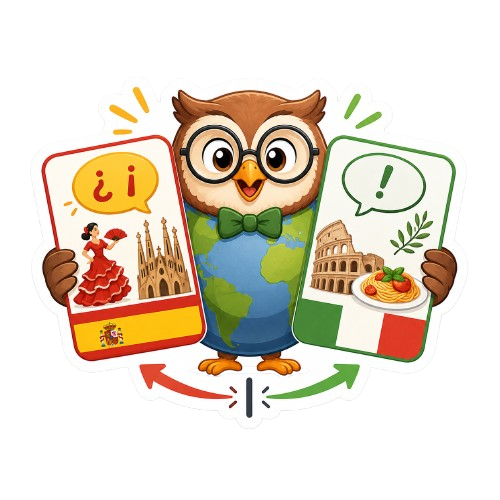
The similarity between Spanish and Italian is easy to explain: both languages belong to the Romance group and have a common Latin source. That is why many words are genuinely similar. Sometimes they can be understood even without a dictionary.
| English | Spanish | Italian |
|---|---|---|
| house | casa | casa |
| book | libro | libro |
| music | música | musica |
| family | familia | famiglia |
| important | importante | importante |
| night | noche | notte |
| good / well | bien | bene |
| friend | amigo | amico |
Not only separate words are similar. Both languages have grammatical gender, articles, singular and plural forms. Verbs change according to person. Personal pronouns often do not need to be pronounced because the verb form already shows who is performing the action.
For example:
Hablo español.
I speak Spanish.
Parlo italiano.
I speak Italian.
In the English translation, “I” appears, but in Spanish and Italian it is not obligatory. The verb itself carries this information.
Word order is also similar in many ways. Usually, the person who performs the action comes first, then the action, then the object. That is why after one Romance language, the second one is indeed easier to perceive. If a person has already studied Spanish, Italian will not seem completely foreign. And vice versa.
But there is an important trap: similarity does not mean sameness. Because of this similarity, students sometimes start transferring rules from one language to another. And then mistakes appear. A word seems familiar, but it is used differently. A construction looks similar, but works in another way. So similarity helps, but it does not replace proper learning.
Differences Between Italian and Spanish
The first difference can be heard by ear. Spanish usually sounds clearer and more rhythmic. Italian sounds softer, smoother, and more emotional. Of course, much depends on the region and the particular person, but the general impression is often exactly like this.
Spanish has sounds that do not exist in standard Italian. For example, j in the words jamón, jugar, México is pronounced with a strong breathy sound. European Spanish also has a characteristic sound in the words gracias, zapato, ciudad. It resembles the English th, and you need to get used to it.
In Italian, the main phonetic difficulty is double consonants. They cannot be “swallowed.” If a word is said too shortly, a native speaker may hear another word. That is why Italian requires a good ear and attention to pronunciation details.
Grammar also differs. In Spanish, a student encounters ser and estar early on. In Italian, this pair does not exist in the same form. Essere is used more often, and the difference between a permanent characteristic and a temporary state is expressed through other means.
Past tenses do not fully match either. In Spanish, there are several forms of the past, and the choice depends on meaning, completion of the action, region, and speech style. In Italian, passato prossimo is used very often, but it is necessary to choose the correct auxiliary verb: essere or avere.
There are also differences in vocabulary. Some words look the same but mean completely different things. For example, the Spanish burro means “donkey,” while the Italian burro means “butter.” Such words are funny, but at the first stages they can easily confuse learners.
The area of use is also different. Spanish is the language of many countries. It is useful in Spain, Latin America, the United States, international business, and travel. Italian is more often chosen because of Italy: culture, fashion, design, architecture, gastronomy, art, or studying at an Italian university.
Which Language Is Easier to Learn?
If we compare Spanish and Italian for a Russian-speaking student, both languages can be called accessible. They do not look as difficult as German with its cases or French with its reading rules. But this does not mean they can be learned “in passing.”
Spanish is often easier at the beginning. The reading rules are clearer, there are a lot of materials, and the number of native speakers is huge. You can quickly find videos, podcasts, series, teachers, and speaking clubs. In addition, Spanish is easy to use in practice: while traveling, texting, working, and using social media.
Italian may seem easier to those who truly love Italy. If a person feels close to Italian cuisine, music, cinema, fashion, architecture, or the atmosphere of the country itself, motivation works more strongly than any difficulty table. When a language is connected to a dream, it is easier to study it.
In terms of grammar, it is not honest to say that one language is easy and the other is difficult. In Spanish, the difficult topics will be ser / estar, past tenses, subjuntivo, and differences between Spanish varieties in different countries. In Italian, they will be double consonants, articles, prepositions, pronouns, and the choice between essere / avere.
If you need the most practical language for communicating with a large number of people, Spanish usually wins. If your goal is connected specifically with Italy, it is better not to choose “useful” Spanish instead of the Italian you truly love. A language is easier to learn when you really need it.
Spanish or Italian: Which Language Is More Beautiful?
It is impossible to give an objective answer here. The beauty of a language is not mathematics. One person hears Spanish and feels energy, temperament, speed, and brightness. Another hears Italian and chooses it for its softness, musicality, and expressiveness.
Spanish is often associated with Latin American music, dancing, travel, sunshine, fast conversations, and lively emotions. It sounds confident and rich. It is especially interesting to listen to different accents: Mexican, Argentinian, Colombian, Spanish.
Italian is perceived differently. It reminds people of opera, art, fashion, beautiful cities, delicious food, and a special lifestyle. It has a lot of intonation, gestures, and melody. Sometimes even an ordinary everyday phrase in Italian sounds expressive.
If you choose only by sound, it is better to simply listen to both languages in real speech. Not educational audio, but interviews, films, blogs, and ordinary conversations. After a few minutes, it usually becomes clear which language resonates more.
But for learning, beauty alone is not enough. It is better to ask yourself: where will I use this language? For Latin America, international communication, travel, and work, Spanish is chosen more often. For Italy, studies, fashion, design, art, gastronomy, or a personal attachment to the country, Italian is the better choice.
Spanish and Italian really are similar, but each has its own character. Spanish is more global and practical. Italian is more intimate, cultural, and musical. And if, over time, you want to learn both, it is completely realistic: after the first Romance language, the second no longer seems so distant.