



For those who study Spanish after Russian, the topic of cases often feels unusual: you want to find endings, but there are almost none. Spanish expresses these meanings differently — through prepositions, the position of the word in the sentence, and pronoun forms.
How many cases are there in Spanish?
Strictly speaking, Spanish nouns do not have the cases we are used to. A word does not change its ending every time its role in the sentence changes. In Russian, we say: дом, дома, дому, домом, о доме. In Spanish, however, the noun usually stays the same, and the needed meaning appears thanks to a preposition or word order.
Let us look at a simple example with the word casa:
Veo una casa.
I see a house.
Estoy en una casa.
I am in a house.
Hablo de una casa.
I am talking about a house.
Voy a una casa.
I am going to a house.
In the English translation, the form of the word does not change either, but in Russian or Ukrainian it would. In Spanish, casa remains casa. Only the small words before it change: en, de, a. They take on the work that endings often do in Russian or Ukrainian.
That is why the expression “cases in Spanish” should be understood conditionally. Spanish does not make you memorize six forms of one noun, but it still shows who performs the action, whom the action is directed at, to whom something is given, what someone is talking about, and with whom something is done.
For example:
el coche de Pedro — Pedro’s car;
una carta para mi madre — a letter for my mother;
trabajo con Luis — I work with Luis;
pienso en mis planes — I think about my plans.
So the case meanings of Russian or Ukrainian do not disappear. Spanish simply expresses them not with endings, but with prepositions and constructions. Pronouns, however, really do change more noticeably: yo, me, mí are different forms, although they may refer to the same person.
Dative case in Spanish
The dative case expresses the meaning of “to whom?” or “to what?”. In Spanish, it is most often connected with the preposition a and the pronouns me, te, le, nos, os, les.
For example:
Escribo a mi amiga.
I am writing to my friend.
Doy el libro a mi hijo.
I give the book to my son.
Compramos flores a la profesora.
We buy flowers for the teacher.
If a pronoun is used instead of the full word, it is usually placed before the verb:
Le escribo.
I am writing to him / her.
Te doy la dirección.
I give you the address.
Nos envían los documentos.
They send us the documents.
The most unusual point for Ukrainian- or Russian-speaking students is that Spanish speakers often use both the pronoun and the clarification with a at the same time:
Le escribo a mi amiga.
I am writing to my friend.
Les explico la tarea a los estudiantes.
I explain the task to the students.
In English, Ukrainian, or Russian, this may sound like repetition, but in Spanish it is completely normal. Moreover, this construction often makes the sentence clearer. Le on its own can mean both “to him” and “to her,” so the clarification a mi amiga immediately removes ambiguity.
Accusative case
The accusative case answers the questions “whom?” and “what?”. In Spanish, this is usually the direct object, meaning the object that the action is directed at.
If we are talking about a thing, no preposition is needed:
Compro pan.
I buy bread.
Leo un mensaje.
I read a message.
Escucho música.
I listen to music.
But with people, an important detail appears — the personal preposition a. It is not translated as a separate word, but in a Spanish sentence it is often necessary.
Veo a Ana.
I see Ana.
Espero a mi hermano.
I am waiting for my brother.
Buscamos al profesor.
We are looking for the teacher.
A mistake like Veo Ana sounds unnatural. It should be Veo a Ana.
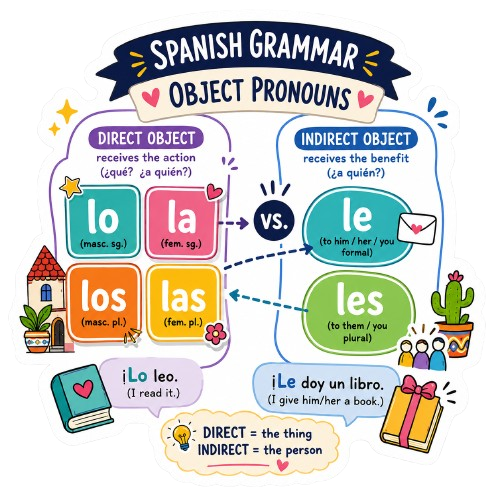
For the direct object, these pronouns are used:
me — me;
te — you;
lo — him / it;
la — her / it;
nos — us;
os — you;
los — them;
las — them.
Examples:
¿Me oyes?
Do you hear me?
La veo en la oficina.
I see her in the office.
Lo necesito hoy.
I need it today.
Los esperamos abajo.
We are waiting for them downstairs.
Here it is important not to confuse lo / la / los / las with le / les. If the question is “whom?” or “what?”, forms of the direct object are usually needed. If the question is “to whom?”, we usually choose le or les.
In Spain, you may hear le veo instead of lo veo when speaking about a man. This is called leísmo. But at the first stages, it is better to follow the basic system, otherwise it is easy to get confused.
Nominative case
The nominative case is the role of the subject. Simply put, it is the person or thing that performs the action, or the person or thing the sentence is about.
Yo estudio español.
I study Spanish.
Mi hermana vive en Madrid.
My sister lives in Madrid.
El café está caliente.
The coffee is hot.
Personal pronouns as subjects are:
yo — I;
tú — you;
él — he;
ella — she;
usted — polite you;
nosotros / nosotras — we;
vosotros / vosotras — you;
ellos / ellas — they;
ustedes — you.
But in Spanish, these pronouns are often omitted. The verb itself shows who performs the action.
Trabajo mucho.
I work a lot.
Vivimos cerca del centro.
We live near the center.
Hablan muy rápido.
They speak very quickly.
A pronoun is added when it is necessary to emphasize the person or contrast them with someone else:
Yo estudio español, y ella estudia francés.
I study Spanish, and she studies French.
Without yo, the phrase would also be grammatically correct, but the emphasis would disappear.
Prepositional case
In Russian or Ukrainian, the prepositional case often appears after words like “about,” “in,” or “on”: about work, in the city, on the table. In Spanish, there is no single universal form for this. Everything depends on the preposition.
Common options are:
de — about, from, possession;
en — in, on;
sobre — about, on the topic of;
con — with;
para — for;
por — because of, due to, through;
a — to, toward.
Examples:
Hablo de mi familia.
I talk about my family.
Vivo en Alicante.
I live in Alicante.
El libro está sobre la mesa.
The book is on the table.
Este regalo es para ti.
This gift is for you.
After prepositions, pronouns also change. You cannot say para yo or de tú. You need:
para mí — for me;
de ti — about you / from you;
con ella — with her;
sin nosotros — without us.
Examples:
Pienso en ti.
I think about you.
Este mensaje es para mí.
This message is for me.
Voy con ellos.
I am going with them.
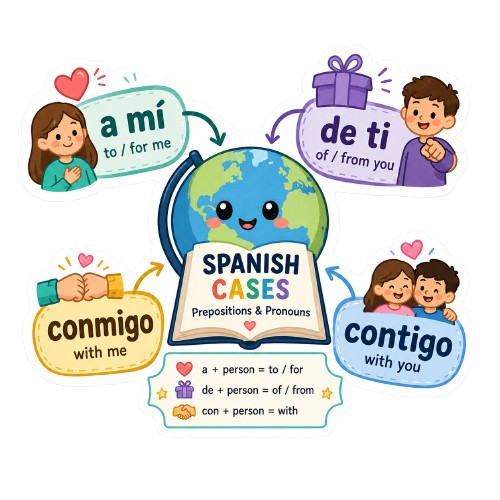
It is worth memorizing conmigo and contigo separately. These are not mistakes, but normal Spanish forms.
Ven conmigo.
Come with me.
Quiero hablar contigo.
I want to talk to you.
Pronoun table
| Role in the sentence | 1st person singular | 2nd person singular | 3rd person singular | 1st person plural | 2nd person plural | 3rd person plural |
|---|---|---|---|---|---|---|
| Subject | yo | tú | él / ella / usted | nosotros/as | vosotros/as | ellos / ellas / ustedes |
| Direct object | me | te | lo / la | nos | os | los / las |
| Indirect object | me | te | le | nos | os | les |
| After a preposition | mí | ti | él / ella / usted | nosotros/as | vosotros/as | ellos / ellas / ustedes |
The difference is easiest to see in short phrases:
Yo veo a Laura.
I see Laura.
Laura me ve.
Laura sees me.
Laura habla de mí.
Laura talks about me.
In the first case, yo is the subject. In the second, me is the object. In the third, mí comes after the preposition de.
So, Spanish does not have noun cases in the form Ukrainian- or Russian-speaking students are used to. But the meanings of “to whom,” “whom,” “about whom,” “with whom,” and “for whom” still exist. They are simply expressed not by endings, but by prepositions, pronouns, and word order. Once this becomes clear, the topic of cases stops seeming difficult: you do not need to look for the form of the word, but for its role in the sentence.