



The levels of Spanish show what exactly a person can already do: whether they can only introduce themselves, maintain a conversation while traveling, work in Spanish, or freely discuss complex topics. Usually, the scale from A1 to C2 is used — from the beginner level to almost professional command of the language.
Table of contents
- A1: Nivel Basico1 — what skills you will get
- A2: Nivel Basico2 — what students can do at this level
- B1: Nivel Independiente — what you will be able to do
- B2: Nivel Superior — what skills you will have
- C1: Nivel Superior 1 — what the student can do
- C2: Nivel Superior 2 — what you will be able to do at this level
- Comparative table of Spanish proficiency levels
A1: Nivel Basico1 — what skills you will get
A1, or Nivel Básico 1, is the very first stage in learning Spanish. At this level, the student is only entering the language: learning to read, pronounce words correctly, understand simple phrases, and build short sentences about themselves.
The main task of A1 is to give a foundation without which it will be difficult to move forward. The student gets acquainted with the Spanish alphabet, stress, simple reading rules, articles, gender and number of nouns. Gradually, the first verbs and the most necessary phrases for communication appear.
After completing this level, a person can say what their name is, where they are from, where they live, what they do, and what languages they study. They can name their age, phone number, profession, country, city, and favorite activities. The student also learns to ask simple questions: what is your name, where do you live, how much does it cost, what time is it, where is the needed place located.
For example, at A1 you can already say:
Me llamo Olga. Soy de Ucrania. Vivo en Valencia. Trabajo y estudio español.
This is not fluent speech yet, but it is already a clear start. A person can take part in a very simple dialogue if the other speaker speaks slowly and uses familiar words. They can order coffee, ask for the bill, say thank you, apologize, clarify the price, or ask someone to repeat something.
At this level, students usually study topics such as family, countries, professions, food, city, transport, days of the week, months, numbers, colors, shopping, and daily routine. In grammar, the verbs ser, estar, tener, llamarse, vivir, trabajar, estudiar, hablar, comer appear in the present tense.
A1 should not be underestimated. Sometimes students think that it is too simple, but this is exactly where the correct foundation is formed. If you learn to calmly build basic phrases, it becomes easier later to move on to tenses, pronouns, and longer sentences.
A2: Nivel Basico2 — what students can do at this level
A2, or Nivel Básico 2, is the level at which the student no longer simply knows separate words, but can deal with everyday situations. Speech becomes longer, phrases become more confident, and there are more topics for communication.
At A2, a person can talk about their day, family, work, studies, habits, plans, and simple past experience. They are able to describe a person, apartment, city, trip, purchase, restaurant, or ordinary everyday situation. If at A1 the student speaks very briefly, at A2 they already connect several thoughts into a short story.
For example:
Ayer fui al centro, compré una chaqueta y después tomé café con una amiga. Me gustó mucho el lugar.
At this level, the student begins to talk more actively about the past. Usually Pretérito Perfecto and Pretérito Indefinido appear, and sometimes the teacher already introduces the first cases of using Pretérito Imperfecto. Thanks to this, the student can explain what they did today, where they went yesterday, where they were in summer, what they bought, whom they met, and what happened.
Vocabulary also becomes more practical. At A2, students study topics needed in real life: hotel, airport, restaurant, transport, doctor, renting housing, shopping, clothes, weather, vacation, schedule, work. The student can understand a simple letter, announcement, message, instruction, or short conversation.
A2 is the level of “I still speak with mistakes, but I can already be understood.” A person can ask again, ask someone to speak more slowly, and explain their thought in other words. This is especially important for travel and life in a Spanish-speaking environment, when it is necessary to quickly solve an ordinary issue: buy a ticket, find an address, make an appointment, or explain a problem.
B1: Nivel Independiente — what you will be able to do
B1, or Nivel Independiente, is the first level at which the student becomes a more independent user of the Spanish language. They can already speak not only according to a textbook, but also in real situations: maintain a conversation, explain their opinion, tell stories, and understand the general meaning of live speech.
At B1, the student begins to feel that the language really works. They can talk about the past, present, and future, describe memories, share plans, talk about events, and express agreement or disagreement. Their speech may still be simple, but it already becomes more natural.
At this level, a person can talk about work, studies, travel, family, films, books, news, personal experience, and everyday problems. They can explain why they made a decision, what they liked or disliked, and what they are going to do next.
An example of speech at B1:
Cuando vivía en mi ciudad, estudiaba inglés y trabajaba por las tardes. Después me mudé a España y empecé a aprender español porque lo necesito para la vida diaria.
At B1, students actively study the difference between past tenses: Pretérito Perfecto, Pretérito Indefinido, Pretérito Imperfecto, and Pluscuamperfecto. Conditional phrases, the imperative mood, object pronouns, and connectors for explaining causes and consequences also appear. Often, it is at this level that the student first seriously encounters Subjuntivo.
B1 is suitable for those who want to feel more confident while traveling, communicating with native speakers, handling simple work situations, or living everyday life in Spain. The student can already explain themselves at a hotel, speak with a doctor, write a message, clarify details, complain about a problem, and discuss plans.
Difficulties still remain. Fast speech by native speakers, humor, slang, films without subtitles, and complex articles can be difficult. But a B1 student no longer gets completely lost: they understand the main idea and can continue the dialogue even if they do not know all the words.
B2: Nivel Superior — what skills you will have
B2, or Nivel Superior, is a level of confident command of Spanish. At this stage, a person can already communicate on different topics, understand fairly complex texts and videos, take part in discussions, and use the language for work, studies, or life abroad.
If at B1 the student often thinks about how to build a phrase, then at B2 speech becomes more automatic. A person no longer translates every word from their native language, but begins to use ready Spanish constructions. They can argue, compare, clarify, debate, give examples, and draw conclusions.
At B2, the student can maintain a conversation with a native speaker without constant pauses. They understand interviews, podcasts, work discussions, articles, letters, instructions, and many videos in Spanish. They can write a detailed message, essay, review, business letter, or explanation of their position.
An example of speech at B2:
Creo que aprender idiomas es una inversión muy útil, porque abre nuevas oportunidades, ayuda a comunicarse con personas de otros países y permite entender mejor diferentes culturas.
At this level, much attention is paid to Subjuntivo. The student learns to use it after expressions of desire, doubt, necessity, emotion, evaluation, and purpose: quiero que, dudo que, es importante que, me alegra que, para que. Conditional sentences, passive constructions, indirect speech, complex conjunctions, and fixed expressions are also studied in more depth.
B2 is often needed for work, relocation, studies, interviews, and comfortable life in a Spanish-speaking country. With this level, a person can already take part in work meetings, explain their tasks, pass interviews, solve administrative issues, and communicate without the constant feeling of helplessness.
Mistakes at B2 are possible, especially in complex grammar or spontaneous speech. But usually they no longer prevent understanding. The main difference of this level is that the student can speak quite freely and flexibly, even if the topic goes beyond everyday communication.
C1: Nivel Superior 1 — what the student can do
C1, or Nivel Superior 1, is an advanced level of Spanish. The student no longer simply communicates, but does so accurately, confidently, and in different styles. They understand complex texts, lectures, interviews, discussions, and can use the language in a professional or academic environment.
At C1, speech becomes richer. A person can choose words not only by meaning, but also by nuance. They understand when it is better to speak neutrally, when formally, and when a more conversational style can be used. It becomes easier for them to feel subtext, emotion, irony, and the speaker’s attitude.
A C1 student can take part in complex discussions, give presentations, write structured texts, explain abstract ideas, defend their position, and analyze information. They are able to read long articles, professional materials, and literary texts without constantly turning to a dictionary.
An example of speech at C1:
Desde mi punto de vista, estudiar una lengua extranjera no significa solo memorizar reglas, sino aprender a interpretar contextos, reaccionar con naturalidad y expresar ideas con precisión.
At this stage, grammar is no longer studied as a set of separate rules. The student learns to use it flexibly. For example, they understand subtle differences in the use of tenses, confidently work with Subjuntivo, and use complex connectors, introductory constructions, periphrases, and fixed expressions.
C1 is especially useful for those who plan to study at a university in Spanish, work in an international company, negotiate, write professional texts, teach, or actively communicate with native speakers on serious topics.
At this level, it is important to develop not only correctness, but also style. The student learns to sound natural: not too bookish, not too simple, and not like a translation from their native language. That is why at C1 a lot of attention is paid to vocabulary, register of speech, argumentation, and work with authentic materials.
C2: Nivel Superior 2 — what you will be able to do at this level
C2, or Nivel Superior 2, is the highest level according to the international scale. It does not automatically make a person a native speaker, but it shows that Spanish can be used in almost any situation: at work, in studies, in public speaking, when reading complex texts, and in free communication.
A C2 student understands practically everything they hear and read, if the topic does not require very narrow specialized knowledge. They can perceive fast speech, different accents, humor, wordplay, cultural references, complex articles, lectures, debates, and literary works.
At this level, a person speaks freely, accurately, and without noticeable searching for words. They can change their style depending on the situation: speak formally at a meeting, persuasively during a presentation, vividly in conversation, and carefully in written text. They have access to subtle shades of meaning, metaphors, emotional nuances, and complex argumentation.
An example of speech at C2:
La riqueza de una lengua se revela no solo en su gramática, sino también en la capacidad de expresar matices, construir argumentos sólidos y comprender la realidad cultural que hay detrás de cada palabra.
Not everyone needs C2. For travel, A2–B1 is usually enough; for work, B2 is often required; for studies and professional communication, B2–C1 is needed. But if a person wants to teach Spanish, write articles, speak publicly, translate, negotiate, or work with the language at a high level, C2 becomes a logical goal.
At C2, the student does not just “know Spanish.” They can use it accurately and beautifully. They can explain one thought in different ways, choose the right register, avoid direct translation from their native language, and quickly correct themselves if a phrase sounds unnatural.
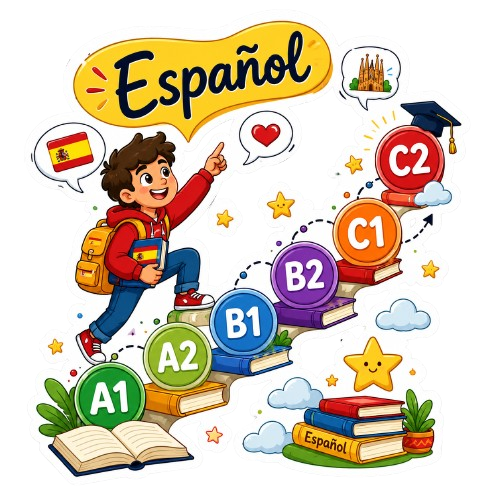
Comparative table of Spanish proficiency levels
| Level | Name | What the student can already do | Example topics | Main goal |
|---|---|---|---|---|
| A1 | Nivel Básico 1 | Introduces themselves, understands simple phrases, asks basic questions | family, city, professions, food, numbers, countries | start speaking in simple sentences |
| A2 | Nivel Básico 2 | Communicates in typical everyday situations, talks about the past and plans | shopping, transport, hotel, health, vacation | confidently deal with everyday tasks |
| B1 | Nivel Independiente | Maintains a conversation, tells stories, explains an opinion | work, studies, travel, personal experience | become an independent language user |
| B2 | Nivel Superior | Communicates more freely, argues, understands more complex speech and texts | profession, society, culture, news | use Spanish for work and life |
| C1 | Nivel Superior 1 | Speaks accurately and flexibly, understands complex materials | academic, business, cultural topics | command the language at an advanced level |
| C2 | Nivel Superior 2 | Uses the language almost without limits, understands nuances | debates, literature, public speaking, analytics | achieve the highest level of fluency |
The levels of Spanish help not to guess whether a person knows the language “well” or “badly,” but to understand specific skills. A1 and A2 give the foundation. B1 and B2 allow the student to become more independent in communication. C1 and C2 open the way to professional, academic, and almost free command of Spanish.
At the same time, a level is not only grammar. It is possible to know many rules but speak poorly. It is possible to understand texts but get lost when listening. That is why, during learning, it is important to develop all skills together: speaking, listening, reading, writing, pronunciation, vocabulary, and confidence.
A level should be chosen not “for show,” but according to your goal. One pace is suitable for travel, another for relocation, and a third for an exam or work. If you study regularly, listen to live speech, complete tasks, and speak a lot in lessons, the transition from one level to the next becomes clear and achievable.