



Spanish tongue twisters help train pronunciation, speech speed, and clarity of articulation. They are especially useful for those who confuse the sounds r, rr, j, ll, ñ, and also want to speak Spanish more confidently and naturally.
Simple Spanish tongue twisters
It is better to start with short tongue twisters. They do not overload memory, but they help you feel the rhythm of Spanish speech. The main thing is not to try to speak quickly right away. First, you need to pronounce the phrase slowly, clearly, and without mistakes. Only then can you increase the tempo.
Simple tongue twisters are suitable for levels A1–A2. They usually repeat individual sounds, syllables, or similar words. Such phrases are good to use as a warm-up before a lesson, speaking practice, or audio recording.
| Tongue twister in Spanish | Translation | What it trains |
|---|---|---|
| Pepe Pecas pica papas con un pico. | Pepe Freckles chops potatoes with a pickaxe. | p, k, clarity of syllables |
| Tres tristes tigres comen trigo. | Three sad tigers eat wheat. | tr, r, t |
| Como poco coco como, poco coco compro. | Since I eat little coconut, I buy little coconut. | c, o, repetition of syllables |
| Pancha plancha con cuatro planchas. | Pancha irons with four irons. | pl, ch |
| El perro de Rita me irrita. | Rita’s dog irritates me. | r, rr |
| Paco compró pocas copas. | Paco bought few glasses. | p, c, o |
| La niña sueña con una piña. | The girl dreams of a pineapple. | ñ |
| Chicho choca con Chacha. | Chicho bumps into Chacha. | ch |
One of the most famous Spanish tongue twisters is Tres tristes tigres comen trigo. It seems simple, but for foreigners there is a difficulty in it: the combination tr must be pronounced clearly, without turning it into an indistinct sound. It is better to start like this: tres — tristes — tigres — trigo, and then put the whole sentence together.
The tongue twister Pepe Pecas pica papas con un pico is good for practicing the sound p. In Spanish, it is usually pronounced more clearly and more dryly than in Ukrainian or Russian. There is no need to add an extra aspirated sound. The phrase should sound even: Pe-pe Pe-cas pi-ca pa-pas.
For the sound ñ, the phrase La niña sueña con una piña is suitable. This sound is similar to a soft “ny,” but it is important not to stretch it too much. First, you can practice individual words: niña, sueña, piña, and then pronounce the whole phrase.
Simple tongue twisters are also useful because they quickly show weak spots. If a person constantly stumbles over one combination, it means that this exact part needs to be repeated separately. It is not worth saying the whole phrase twenty times in a row with the same mistake. It is better to isolate the difficult piece and practice it slowly.
Medium-level tongue twisters
Medium-level tongue twisters already require more concentration. They contain longer phrases, similar words, repetitions of verbs, and complex consonant combinations. Such exercises are suitable for students who already read in Spanish and want to improve speech fluency.
El cielo está enladrillado, ¿quién lo desenladrillará? El desenladrillador que lo desenladrille, buen desenladrillador será.
The sky is laid with bricks; who will unbrick it? The unbricker who unbricks it will be a good unbricker.
This tongue twister trains long words and the prefix des-. It is difficult not only for pronunciation, but also for memory. It is better to divide it into parts:
El cielo está enladrillado
¿quién lo desenladrillará?
El desenladrillador que lo desenladrille
buen desenladrillador será
After that, the parts can be connected into one text.
Another good example:
Cuando cuentas cuentos, cuenta cuántos cuentos cuentas.
When you tell stories, count how many stories you tell.
Here the words cuentas, cuentos, cuántos are repeated. They are similar, but they perform different functions. The tongue twister helps train not only pronunciation, but also attention to meaning.
Si Sansón no sazona su salsa con sal, le sale sosa.
If Samson does not season his sauce with salt, it comes out bland.
This phrase is suitable for the sound s. In Spanish, especially in the European variety, it is important to distinguish s, c, and z depending on the region. But even if a student is learning a Latin American variety, clarity of the sound s is still needed.
Compré pocas copas, pocas copas compré.
I bought few glasses; few glasses I bought.
Here the difficulty is in the rearrangement of words. The brain already gets used to one structure and then receives almost the same phrase in reverse order. This is useful for automating speech.
María Chucena techaba su choza, y un techador que por allí pasaba le dijo: María Chucena, ¿tú techas tu choza o techas la ajena?
María Chucena was roofing her hut, and a roofer who was passing by said to her: María Chucena, are you roofing your hut or someone else’s?
This tongue twister trains ch, t, j, and switching between similar words: techar, choza, techador. It sounds almost like a little story, so it is easier to memorize not mechanically, but through an image.
Medium-level tongue twisters are better pronounced in three stages. The first stage is slowly and with pauses. The second is at a normal conversational tempo. The third is faster, but without losing clarity. If mistakes appear at the third stage, it means the speed is still too high.
Difficult Spanish tongue twisters
Difficult tongue twisters are suitable for those who already read confidently and want to reduce their accent, improve diction, or prepare for public speaking. They often contain long chains of similar sounds, unusual words, and quick transitions from one articulatory position to another.
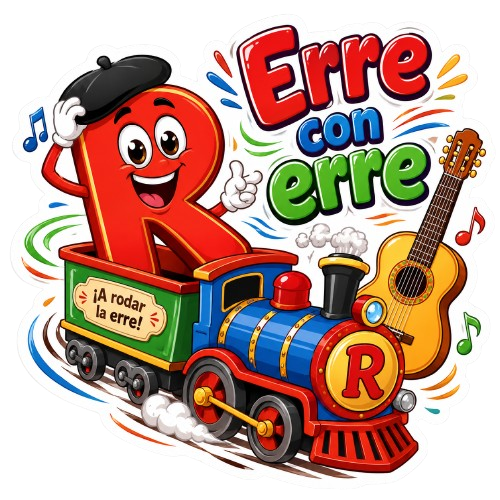
Erre con erre guitarra, erre con erre barril, rápido ruedan los carros, rápido el ferrocarril.
“R” with “r” — guitar, “r” with “r” — barrel, carts roll quickly, the train goes quickly.
This is a classic tongue twister for the sound rr. For many students, the Spanish vibrating rr becomes the main problem. It is important not to try to pronounce it with the throat. The sound appears when the tip of the tongue vibrates near the alveolar ridge, that is, in the upper part behind the teeth.
At first, you can train not the whole tongue twister, but separate pieces:
erre con erre
rápido ruedan
los carros
el ferrocarril
Only then should you connect the whole sentence.
The next tongue twister is difficult because of the repetition of r, p, c, and similar syllables:
Parra tenía una perra, Guerra tenía una parra. La perra de Parra subió a la parra de Guerra.
Parra had a dog, Guerra had a grapevine. Parra’s dog climbed onto Guerra’s grapevine.
Here it is important not to lose the difference between Parra, perra, and parra. To a Ukrainian or Russian ear, these words may merge, but in Spanish they differ in sound and meaning.
A very difficult tongue twister:
El arzobispo de Constantinopla se quiere desarzobispoconstantinopolizar. El desarzobispoconstantinopolizador que lo desarzobispoconstantinopolice, buen desarzobispoconstantinopolizador será.
The archbishop of Constantinople wants to stop being the archbishop of Constantinople. The one who helps him stop being the archbishop of Constantinople will be a good “de-archbishop-of-Constantinople-izer.”
This is almost a joking monster. It should not be used in the first lesson. It is useful for training long words, breathing, and speech stability. The main secret is to break the word into parts:
des-ar-zo-bis-po-cons-tan-ti-no-po-li-zar
If you try to pronounce everything at once, your tongue will almost certainly get tangled.
Another difficult phrase:
Me han dicho que has dicho un dicho que he dicho yo. Ese dicho está mal dicho, pues si yo lo hubiera dicho, estaría mejor dicho que el dicho que has dicho que he dicho yo.
I was told that you said a saying that I said. This saying is badly said, because if I had said it, it would have been said better than the saying that you said I said.
Here d, ch, h as a silent letter are trained, as well as the repetition of the word dicho in different positions. The tongue twister is good for those who want to speak more smoothly and not get lost in long Spanish phrases.
Difficult tongue twisters should not be read only with the eyes. They need to be pronounced out loud, preferably recording yourself and listening from the outside. Sometimes a person thinks they are speaking clearly, but on the recording it is heard that endings disappear, r does not vibrate, and similar words turn into one.

Spanish tongue twisters for practicing sounds
Different tongue twisters help train different sounds. This is more convenient than taking a random phrase and repeating it without a goal. If a student has trouble with rr, they do not need ten tongue twisters with ch. If the sound j is difficult, it is better to choose exercises specifically for it.
| Sound | Tongue twister | Translation |
|---|---|---|
| r / rr | Erre con erre guitarra, erre con erre barril. | “R” with “r” — guitar, “r” with “r” — barrel. |
| tr | Tres tristes tigres tragan trigo. | Three sad tigers swallow wheat. |
| ch | Chiqui chiquita choca con Chucho. | Little Chiqui bumps into Chucho. |
| ñ | La niña sueña con una piña pequeña. | The girl dreams of a small pineapple. |
| j | Juan junta jarras junto al jardín. | Juan gathers pitchers next to the garden. |
| ll / y | Yo ya llamé a Yolanda. | I have already called Yolanda. |
| s | Si seis sierras sierran seis cipreses. | If six saws saw six cypress trees. |
| p | Pepe Pecas pica papas con un pico. | Pepe Freckles chops potatoes with a pickaxe. |
For the sound j, you can use the phrase:
Jorge juega junto al jardín con juguetes japoneses.
Jorge plays next to the garden with Japanese toys.
The Spanish j is pronounced deeper and harder than the Ukrainian “kh,” especially in Spain. But there is no need to turn it into an aggressive cough. The sound should be strong, but controlled.
For ll and y, this phrase is suitable:
Yo ya llamé a Yolanda y Yolanda ya llegó.
I have already called Yolanda, and Yolanda has already arrived.
In different countries, these sounds may be pronounced differently. In some regions, ll and y sound almost the same; in others, they differ noticeably. For the student, it is more important first to choose the pronunciation variety they are learning: Spain, Mexico, Argentina, or another region.
For the combination tr:
Tres trenes traen trigo tras tres tractores.
Three trains carry wheat behind three tractors.
Here you need to make sure that tr does not turn into a heavy Ukrainian or Russian “tr.” The Spanish sound is more compact and faster.
For s:
Susana sale sola si sale el sol.
Susana goes out alone if the sun comes out.
This phrase is simple, but useful. It helps not to swallow s at the beginning and in the middle of words. In some Spanish regions, final s may weaken, but for learning pronunciation it is better first to learn to pronounce it clearly.
How to work with tongue twisters correctly
The main mistake is trying to speak quickly right away. A tongue twister is needed not for chaos, but for control. If a person pronounces the phrase quickly, but half of the sounds disappear, there is almost no benefit. Speed should appear only after accuracy.
Proper work with a tongue twister begins with understanding. First, you need to translate the phrase and analyze the words. If a student does not understand what they are saying, they will simply repeat a set of sounds. This is harder to remember and becomes tiring faster.
Next, it is worth identifying the difficult sound. For example, in the tongue twister Erre con erre guitarra, the main goal is rr. In the phrase La niña sueña con una piña, it is the sound ñ. In Juan junta jarras, it is the sound j. When the goal is clear, the training becomes conscious.
A good working scheme:
- Read the tongue twister silently.
- Translate it and understand the general meaning.
- Divide the phrase into short pieces.
- Pronounce each piece slowly.
- Connect the pieces into one phrase.
- Repeat at a normal tempo.
- Speed up only when there are no mistakes.
- Record yourself on a voice recorder and check the sound.
For example, let us take the phrase:
Tres tristes tigres comen trigo.
There is no need to repeat it ten times right away. It is better to do it like this:
tres
tristes
tigres
comen trigo
tres tristes tigres
tres tristes tigres comen trigo
This way the tongue gradually gets used to the combinations. This method is much more effective than uncontrolled repetition of the whole phrase.
Another useful technique is to change the volume and tempo. First say it quietly and slowly, then in a normal voice, then a little faster. You can pronounce the phrase like an announcer, like an actor, like a child, like a person who is surprised or angry. This is not nonsense: emotions help remove tension and make speech livelier.
It is important not to practice for too long. It is better to practice 5–7 minutes every day than to torture your tongue for half an hour once a week. Articulation works like a muscle: it needs regularity, but not overload.
If a tongue twister does not work at all, you should not consider yourself incapable of languages. Perhaps the phrase is simply too difficult for the current level. Then it is better to return to shorter options. For example, before Erre con erre guitarra, you can practice separate words: rojo, perro, carro, rápido, rueda.
Spanish tongue twisters are useful not only for pronunciation. They develop listening, attention to detail, memory, and confidence in speech. With their help, a student notices the difference between similar sounds faster, stops being afraid of long words, and begins to feel the rhythm of the Spanish language better. The main thing is to work with them calmly, regularly, and consciously.