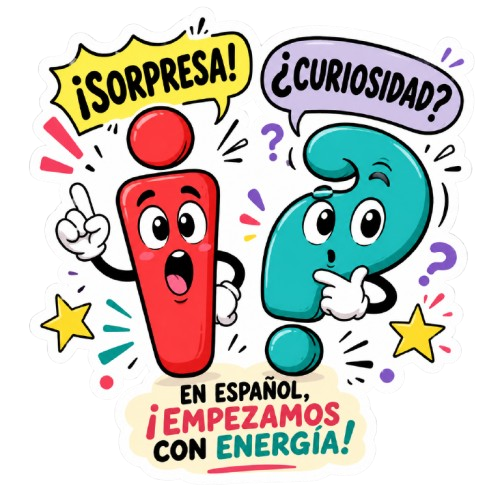
You open a Spanish text, and your eye immediately catches something unusual. Punctuation marks appear not only at the end of a sentence but also at the very beginning, and upside down at that. ¿Strange? ¡Very much so! But behind this peculiarity lies a very reasonable logic.
How Inverted Marks Appeared in Spanish?
The middle of the 18th century. The Royal Spanish Academy set out to solve a problem that had long irritated literate readers: you read a long sentence to the end and only there discover a question mark. You have already chosen the wrong intonation, and rereading feels awkward.
In 1754, the Academy made a decision — to introduce opening punctuation marks. The logic was simple: if the reader needs to know the tone of a phrase in advance, show it at the very beginning. The inverted mark at the beginning of a sentence is a kind of conductor’s gesture: here there will be a question, and here there will be emotion.
At first, the rule was only a recommendation. Writers and journalists adopted it gradually, without much enthusiasm. But by the middle of the 19th century, the inverted marks had firmly established themselves in Spanish writing and turned from a recommendation into a mandatory norm.
What is important to understand is that this phenomenon is unique to Spanish. Neither Portuguese, Italian, nor French — no other Romance language followed this path. Catalan used inverted marks for a time but later abandoned them. Spanish remained faithful to the tradition, and today these two small symbols instantly identify a Spanish text among all others.
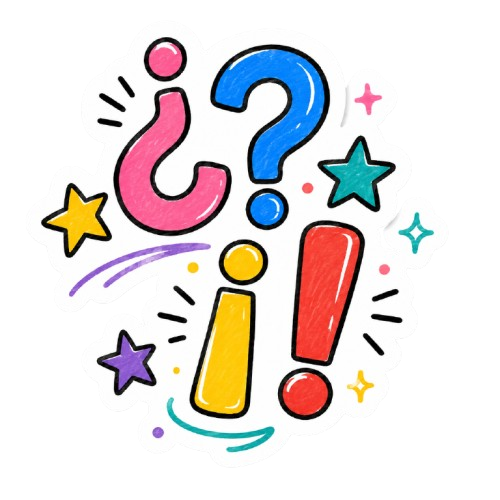
What the Inverted Question Mark Means in Spanish?
The symbol ¿ is neither decoration nor a typo. It is placed exactly where the question begins and works together with the regular ? at the end. Together, they place the interrogative part of the sentence inside a kind of bracket.
When the entire question is a standalone sentence, the opening mark is placed before the first word. When the question is embedded within a longer phrase, the mark is placed not at the beginning of the entire construction but precisely before the part where the interrogative intonation begins.
| Situation | Example | Translation |
|---|---|---|
| Separate question | ¿Hablas español? | Do you speak Spanish? |
| Question after an introduction | Oye, ¿tienes un momento? | Listen, do you have a moment? |
| Several questions in a row | ¿Qué pasó? ¿Cuándo llegaste? | What happened? When did you arrive? |
| Question inside a phrase | No entiendo, ¿qué quieres decir? | I don’t understand, what do you mean? |
A typical beginner’s mistake is to place ¿ at the very beginning of the sentence even when the question starts later. For example: ¿Dime, qué piensas? — incorrect. Correct: Dime, ¿qué piensas? The opening mark must appear exactly at the beginning of the interrogative intonation, neither earlier nor later.
What the Inverted Exclamation Mark Means in Spanish?
The symbol ¡ is the twin brother of the inverted question mark, but it is responsible for emotion. It opens an exclamatory sentence or an exclamatory part of a phrase, and the regular ! closes it at the end.
Most often, ¡ appears in short emotional constructions — congratulations, exclamations, calls to action: ¡Felicidades!, ¡Vamos!, ¡Qué suerte! Especially productive are combinations with the pronoun qué — through them Spanish expresses admiration, surprise, horror, or joy: ¡Qué maravilla! (How wonderful!), ¡Qué desastre! (What a disaster!).
When a sentence is both interrogative and emotional, both marks stand together: ¡¿Pero qué estás haciendo?! In informal correspondence, Spaniards like to double or triple the marks for emphasis: ¡¡¡Increíble!!! — and the Academy looks upon this without approval, but language lives its own life.
By the way, in the age of smartphones, young Spaniards often omit the opening marks altogether — writing Qué bien! instead of ¡Qué bien! This is not considered correct, but in messaging apps it is extremely common. Living language is always a little ahead of academic norms, and Spanish is no exception in this respect.