



If you are just starting to learn German, you’ve probably already come across long constructions like auf dem Tisch, mit dem Freund or von dem Buch. But Germans don’t like unnecessary words — instead of these combinations they often use special short forms: darauf, damit, davon. These are called pronominal adverbs. At first sight, they may seem strange or even intimidating, but in reality, they are a handy tool that saves time and makes speech sound more natural. In this article, we’ll look at how these adverbs work, the rules for forming them, and the situations in which they are used. We’ll check real examples, compare different forms, and even analyze common mistakes students make. At the end, you’ll find a table with translations and practice exercises — so the material will be not only theoretical but also practical, and pronominal adverbs will stop being “scary grammar” and become your helper in communication.
Table of contents
- What Are Pronominal Adverbs?
- How Pronominal Adverbs Are Formed (da + preposition / wo + preposition)
- When to Use -r- Between the Adverb and the Preposition
- Interrogative Pronominal Adverbs (wo- forms)
- Demonstrative Pronominal Adverbs (da- forms)
- Frequently Used Pronominal Adverbs with Examples
- Table of Pronominal Adverbs with Translation
- Typical Mistakes When Using Pronominal Adverbs
- Practical Exercises for Practice
What Are Pronominal Adverbs?
Pronominal adverbs in German are special words that replace whole “preposition + noun” combinations and make the sentence shorter. For example, instead of the bulky auf dem Tisch, Germans often use the compact darauf. Essentially, the idea is to insert a short word instead of repeating long constructions — one that points directly to both the preposition and the object. This makes the sentence sound natural and the speech faster and easier to understand.
Their main feature: they are used only with inanimate objects or abstract concepts. If you are talking about a person, such substitution is impossible. That’s why in German it is correct to say Ich warte darauf (“I’m waiting for it”), but you cannot use a pronominal adverb when emphasizing a person — there you must keep the pronoun construction: Ich warte auf ihn.
So, pronominal adverbs act like “links” in speech: instead of repeating the same phrase again and again, we use one short word, and the listener immediately understands what is meant. For native speakers, this is a natural part of the language, but for learners it may be surprising. However, once you catch the principle, the system will seem logical and even convenient.
How Pronominal Adverbs Are Formed (da + preposition / wo + preposition)
The formation of pronominal adverbs in German follows a fairly simple principle. First comes the base da- (for statements or references) or wo- (for questions), and then the required preposition is added. The result is forms like damit (“with it”), davon (“from it”), darauf (“on it”), and also womit (“with what?”), wovon (“about what?”), worauf (“on what?”).
In this way, a small prefix turns an ordinary preposition into part of a new word that replaces an entire phrase. Important: such words are never used for people — only for objects, ideas, or events. While in Russian or English we often repeat “with this”, “about this”, “to this”, in German everything is reduced to one compact word.
For learners, this system may seem confusing at first, but in practice it saves a lot of time: instead of a long repetition, you just put damit or womit — and the idea is expressed quickly and precisely.
When to Use -r- Between the Adverb and the Preposition
There is one small but important rule: the insertion of the letter -r- between the base da-/wo- and the preposition. This happens when the preposition begins with a vowel. For example, instead of da+auf = daauf, the correct form is darauf. The same works with questions: wo+über becomes worüber.
Why is this necessary? Simply for easier pronunciation. Germans add -r- to smooth the sound and avoid awkward vowel collisions. This little letter works like a connector that makes speech flow naturally.
So always remember: if the preposition begins with a vowel (auf, in, unter, über, etc.), insert -r- after da- or wo-. This is not an exception, but the standard rule.
Interrogative Pronominal Adverbs (wo- forms)
Interrogative pronominal adverbs in German are formed with wo- plus a preposition. They are used when asking about an inanimate object or an abstract concept. Examples:
- Womit schreibst du? — “What do you write with?”
- Worüber sprecht ihr? — “What are you talking about?”
- Wovon träumst du? — “What do you dream about?”
In English, such questions are usually expressed with “with what”, “about what”, “on what”, while in German a single short word replaces them.
And as already mentioned, if the preposition starts with a vowel, insert -r- between wo- and the preposition: wo + auf → worauf, wo + in → worin, wo + unter → worunter.
Important: wo- forms always refer to inanimate things. You cannot say Womit sprichst du mit Maria? — that would be wrong. If it’s a person, the correct form is with a pronoun: Mit wem sprichst du? (“Who are you talking to?”).
Thus, interrogative pronominal adverbs allow you to ask questions in the most concise way.
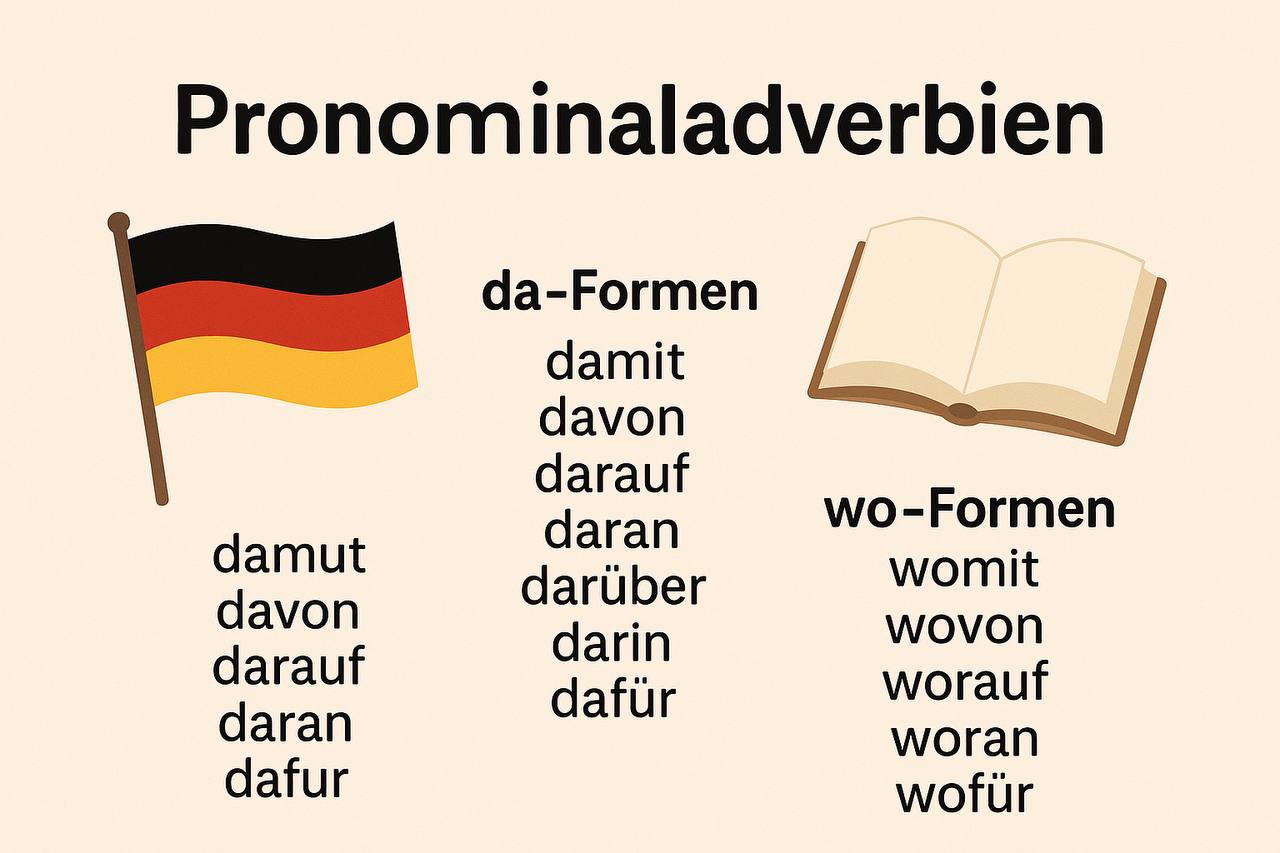
Demonstrative Pronominal Adverbs (da- forms)
Demonstrative pronominal adverbs in German are formed with da- plus a preposition. They are used when referring to an object or situation already mentioned. They work like a short link in conversation: instead of “about this”, “with this”, “on this”, Germans simply say darüber, damit, darauf.
Examples:
- Ich warte darauf. — “I’m waiting for it.”
- Sie spricht darüber. — “She is talking about it.”
- Wir freuen uns darüber. — “We’re glad about it.”
- Er arbeitet damit. — “He works with it.”
Here too, the -r- rule applies before prepositions starting with a vowel.
Frequently Used Pronominal Adverbs with Examples
- damit — “with it” (Ich bin zufrieden damit. — “I’m satisfied with it.”)
- davon — “from it, about it” (Er hat nichts davon gewusst. — “He didn’t know anything about it.”)
- darauf — “on it” (Ich freue mich darauf. — “I’m looking forward to it.”)
- daran — “about it, to it” (Er erinnert sich daran. — “He remembers it.”)
- darüber — “about it, over it” (Wir lachen darüber. — “We laugh about it.”)
- darin — “in it” (Das Problem liegt darin. — “The problem lies in it.”)
- dafür — “for it” (Ich bin dafür. — “I’m in favor of it.”)
And their interrogative counterparts:
- womit — “with what?”
- wovon — “about what?”
- worauf — “on what?”
- woran — “about what? / to what?”
- worüber — “about what?”
- worin — “in what?”
- wofür — “for what?”
Table of Pronominal Adverbs with Translation
| Demonstrative (da- + prep.) | Interrogative (wo- + prep.) | Translation |
|---|---|---|
| damit | womit | with it / with what |
| davon | wovon | from it, about it / about what |
| darauf | worauf | on it / on what |
| daran | woran | about it, to it / about what, to what |
| darüber | worüber | about it, over it / about what, over what |
| darin | worin | in it / in what |
| dafür | wofür | for it, for this / for what |
| dagegen | wogegen | against it / against what |
| dazu | wozu | to it, for it / to what, for what |
| dabei | wobei | with it / with what |
| darunter | worunter | under it / under what |
| darüber hinaus | worüber hinaus | beyond that / beyond what |
Typical Mistakes When Using Pronominal Adverbs
Although pronominal adverbs seem logical and convenient, they often cause difficulties for learners. The most common mistake is trying to use them with people. For example, some students say Ich spreche darüber mit Maria meaning “I talk with Maria”, but that’s wrong. If it’s about a person, pronominal adverbs cannot be used: you must use a personal pronoun with the preposition: Ich spreche mit ihr.
The second mistake is confusing the preposition required. In English or Russian, we often just say “about something”, but in German each verb strictly requires its own preposition. For example: warten auf (“to wait for”), träumen von (“to dream of”), denken an (“to think of”). Mixing them up makes the sentence sound strange or meaningless.
The third mistake is ignoring the insertion of -r-. Forms like daauf or woin are impossible, and a native speaker will notice the error immediately. So the -r- rule must become automatic.
The fourth mistake is overuse. Some learners, once they discover pronominal adverbs, start putting them everywhere, even when it’s simpler to use a normal pronoun. Remember: they are a tool for simplification, not a universal replacement.
To avoid these problems, it’s helpful to practice with real examples and check yourself: is the preposition correct? Is the adverb suitable for the situation? Are we talking about a person? With practice, these checks become automatic and the mistakes disappear.
Practical Exercises for Practice
Understanding the theory is one thing; actually using pronominal adverbs in real speech is another. To make sure they don’t remain just rules in a textbook, you need to practice them in different situations.
Start simple: take a verb with a preposition, for example warten auf (“to wait for”). Make a normal sentence: Ich warte auf den Bus. Now shorten it with a pronominal adverb: Ich warte darauf. Do the same with other verbs: denken an → daran denken, sprechen über → darüber sprechen, träumen von → davon träumen.
It’s also useful to practice questions. Transform them: Mit was schreibst du? becomes Womit schreibst du?, Über was sprecht ihr? turns into Worüber sprecht ihr?. The more transformations you do, the more natural they become.
A great exercise is mini-dialogues. One person asks: Worauf wartest du? The other answers: Darauf warte ich schon lange. This back-and-forth helps not only with memorization but with using them in live situations.
You can even make it a game: write down prepositions (auf, über, mit, von, in, für) and try to form as many da- / wo- pairs as possible. Check yourself with the table and create your own sentences.
The main thing: don’t be afraid of mistakes. Even if it sounds clumsy at first, keep practicing. In a few weeks, you’ll notice that pronominal adverbs come out automatically and your German will sound more natural and “native-like.”