



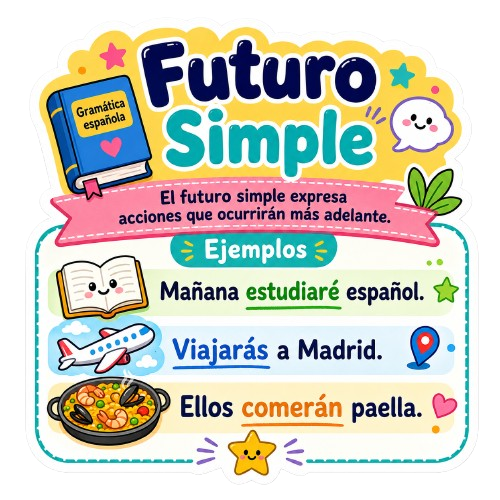
Futuro Simple is the simple future tense in Spanish. It is used to talk about actions that will happen later: tomorrow, next week, in a year, or at some undefined moment in the future. This tense is also used for forecasts, promises, and assumptions.
How the Simple Future Tense Is Formed in Spanish
Futuro Simple is formed quite conveniently: special endings are added to the infinitive of the verb. Unlike many other tenses, here you do not need to remove the endings -ar, -er, -ir. The infinitive remains complete, and the necessary ending is simply added to it.
The endings of Futuro Simple are the same for all three verb groups:
| Person | Ending | hablar | comer | vivir |
|---|---|---|---|---|
| yo | -é | hablaré | comeré | viviré |
| tú | -ás | hablarás | comerás | vivirás |
| él / ella / usted | -á | hablará | comerá | vivirá |
| nosotros/as | -emos | hablaremos | comeremos | viviremos |
| vosotros/as | -éis | hablaréis | comeréis | viviréis |
| ellos / ellas / ustedes | -án | hablarán | comerán | vivirán |
For example:
Mañana hablaré con el profesor.
Tomorrow I will speak with the teacher.
El domingo comeremos en casa.
On Sunday we will eat at home.
Ellos vivirán en Madrid.
They will live in Madrid.
The main rule is this: in regular verbs, the form is built from the full infinitive. That is why a student does not need to memorize three separate patterns for -ar, -er, and -ir verbs. It is enough to learn one set of endings.
Let’s compare:
trabajar — trabajaré
I will work
aprender — aprenderé
I will learn
escribir — escribiré
I will write
In English, the future is often expressed with “will” or “be going to.” In Spanish, Futuro Simple can correspond to both variants depending on context.
Te llamaré más tarde.
I will call you later.
Estudiaremos este tema mañana.
We will study this topic tomorrow.
Compraré los billetes esta noche.
I will buy the tickets tonight.
Rules for Using Futuro Simple in Spanish
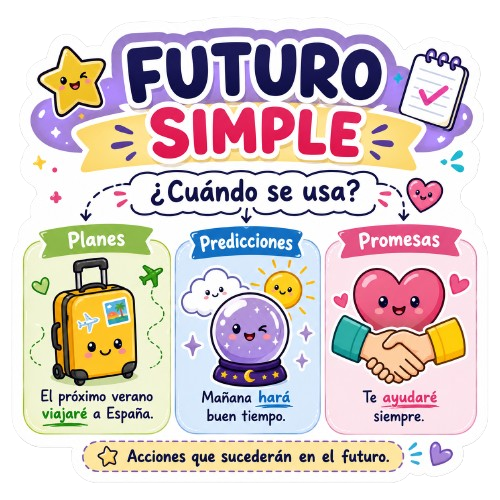
Futuro Simple is used when an action refers to the future. It can be a plan, a promise, a forecast, a decision, or an assumption. But it is important to understand that in everyday speech, Spanish speakers do not always choose Futuro Simple for near-future plans. Very often they use the construction ir a + infinitivo. For example, voy a estudiar means “I am going to study.” Still, Futuro Simple remains an important tense, especially in written speech, forecasts, official messages, and a more neutral style.
Futuro Simple is suitable when we talk about a future fact:
El curso empezará en septiembre.
The course will start in September.
La clase terminará a las ocho.
The lesson will end at eight.
Recibirás la respuesta mañana.
You will receive the answer tomorrow.
This tense is also used for promises:
Te ayudaré.
I will help you.
No lo olvidaré.
I will not forget it.
Siempre estaré contigo.
I will always be with you.
Another important function is forecasts and assumptions about the future:
Creo que lloverá mañana.
I think it will rain tomorrow.
España ganará el partido.
Spain will win the match.
Será un viaje interesante.
It will be an interesting trip.
Sometimes Futuro Simple expresses not an exact future action, but an assumption about the present. This is especially interesting for students, because in English we would often say “probably.”
¿Dónde está Ana? — Estará en casa.
Where is Ana? — She is probably at home.
Serán las diez.
It is probably ten o’clock now.
Tendrá mucho trabajo.
He probably has a lot of work.
So Futuro Simple can answer not only the question “what will happen?”, but also “what is probably happening now?”
Time Markers
Futuro Simple is often used with words and expressions that point to the future. They help you understand faster why this tense is being used.
| Marker | Translation |
|---|---|
| mañana | tomorrow |
| pasado mañana | the day after tomorrow |
| la semana que viene | next week |
| el mes que viene | next month |
| el año que viene | next year |
| pronto | soon |
| más tarde | later |
| dentro de dos días | in two days |
| en el futuro | in the future |
| algún día | someday |
Examples:
Mañana estudiaré gramática.
Tomorrow I will study grammar.
La semana que viene visitaremos Barcelona.
Next week we will visit Barcelona.
Algún día hablaré español con fluidez.
Someday I will speak Spanish fluently.
Dentro de un año viviré en otro país.
In a year, I will live in another country.
Examples
To understand Futuro Simple better, it is useful to look at it in short, natural phrases.
Haré la tarea por la noche.
I will do the assignment in the evening.
Tú aprenderás muchas palabras nuevas.
You will learn many new words.
Ella trabajará desde casa.
She will work from home.
Nosotros viajaremos en verano.
We will travel in summer.
Vosotros recibiréis el correo mañana.
You will receive the email tomorrow.
Ellos comprarán una casa.
They will buy a house.
Futuro Simple is convenient for plans that sound calm and confident. For example, when a student talks about their goals:
Aprenderé español y podré comunicarme en viajes.
I will learn Spanish and will be able to communicate while traveling.
Leeré libros sencillos y veré series en español.
I will read simple books and watch series in Spanish.
Irregular Verbs in Futuro Simple
In Futuro Simple, irregular verbs change not the endings, but the stem. This is good news: the endings remain the same as in regular verbs. You only need to memorize the special stem.
For example, the verb tener in the future tense is not formed as teneré, but as tendré.
tener — tendré
I will have
salir — saldré
I will leave / go out
hacer — haré
I will do / make
Exception Verbs
The most important irregular stems in Futuro Simple are:
| Infinitive | Futuro Simple Stem | yo Form | Translation |
|---|---|---|---|
| tener | tendr- | tendré | I will have |
| venir | vendr- | vendré | I will come |
| salir | saldr- | saldré | I will leave |
| poner | pondr- | pondré | I will put |
| hacer | har- | haré | I will do / make |
| decir | dir- | diré | I will say |
| poder | podr- | podré | I will be able to |
| saber | sabr- | sabré | I will find out / know |
| querer | querr- | querré | I will want |
| haber | habr- | habrá | there will be |
| valer | valdr- | valdré | I will be worth |
| caber | cabr- | cabré | I will fit |
After the irregular stem, the regular endings are added:
tendré, tendrás, tendrá, tendremos, tendréis, tendrán
haré, harás, hará, haremos, haréis, harán
podré, podrás, podrá, podremos, podréis, podrán
So the pattern remains logical: only the “middle” of the verb changes, while the future tense endings stay the same.
Examples of Irregular Verbs
Tendré más tiempo mañana.
I will have more time tomorrow.
Vendremos a las seis.
We will come at six.
Saldrán después de la clase.
They will leave after the lesson.
Pondré los documentos en la mesa.
I will put the documents on the table.
Haré todo lo posible.
I will do everything possible.
Te diré la verdad.
I will tell you the truth.
No podré ir hoy.
I will not be able to go today.
Sabrás la respuesta pronto.
You will know the answer soon.
Habrá mucha gente en el evento.
There will be many people at the event.
Mistakes most often appear when a student tries to form the future tense according to regular logic: teneré, haceré, deciré. These forms do not exist. You need to say tendré, haré, diré.
Difference Between Futuro Simple and Other Future Forms
In Spanish, there are several ways to talk about the future. The most common are Futuro Simple, the construction ir a + infinitivo, and Presente de Indicativo with a future meaning.
Futuro Simple sounds neutral, sometimes more official or confident. It is often used in forecasts, promises, written speech, news, and announcements.
Mañana lloverá.
It will rain tomorrow.
El curso empezará en octubre.
The course will start in October.
The construction ir a + infinitivo is more often used for near-future plans and intentions. It sounds very natural in spoken language.
Voy a estudiar esta noche.
I am going to study tonight.
Vamos a comprar billetes.
We are going to buy tickets.
Presente de Indicativo can also refer to the future if there is a clear time marker. Usually, this is used for schedules or fixed plans.
Mañana tengo clase.
I have a lesson tomorrow.
El tren sale a las ocho.
The train leaves at eight.
Let’s compare:
| Form | Example | When to Use |
|---|---|---|
| Futuro Simple | Estudiaré mañana. | forecast, promise, neutral future |
| ir a + infinitivo | Voy a estudiar mañana. | intention, near-future plan |
| Present with future meaning | Mañana estudio. | schedule, arrangement, fixed plan |
If you are just starting to learn Spanish, you can remember a simple rule: for everyday personal plans, use ir a + infinitivo more often; for forecasts, promises, assumptions, and a more formal future, use Futuro Simple.
Voy a llamar a mi madre.
I am going to call my mother. This is a personal near-future plan.
Te llamaré mañana.
I will call you tomorrow. This is a promise or a confident decision.
Futuro Simple in Spanish is not difficult to form: the endings -é, -ás, -á, -emos, -éis, -án are added to the infinitive. The most important thing is to learn the main irregular stems and understand when this tense sounds natural. Then you will be able to talk about the future more accurately: make plans, give promises, make forecasts, and express assumptions.