



Imperativo negativo is used when we want to ask someone not to do something, give advice, or prohibit an action. In English, these are phrases such as “don’t speak,” “don’t hurry,” “don’t open,” or “don’t worry.” In Spanish, such commands are formed according to special rules.
How to Use Imperativo Negativo in Spanish
In Spanish, the imperative mood is not used only for strict orders. Very often, it is a simple request, piece of advice, instruction, or warning. If the sentence is negative, no is placed before the verb.
For example:
No hables.
Don’t speak.
No corras.
Don’t run.
No abras la puerta.
Don’t open the door.
No lleguéis tarde.
Don’t be late.
At first glance, it may seem that it is enough to put no before a regular command. But in Spanish, it does not work that way. The negative form of the imperative is not formed like the affirmative one. After no, you use a form that matches presente de subjuntivo.
Let’s compare:
Habla más despacio.
Speak more slowly.
No hables tan rápido.
Don’t speak so fast.
Come la sopa.
Eat the soup.
No comas tanto azúcar.
Don’t eat so much sugar.
Abre el libro.
Open the book.
No abras el libro todavía.
Don’t open the book yet.
This is where students often make mistakes. They memorize the affirmative forms habla, come, abre, and then try to say no habla, no come, no abre. For addressing someone as “tú,” that would be incorrect. You need to say: no hables, no comas, no abras.
Imperativo negativo can sound soft when it is advice:
No te preocupes.
Don’t worry.
No tengas miedo.
Don’t be afraid.
No pienses demasiado.
Don’t think too much.
It is also used in requests:
No me llames tan tarde.
Don’t call me so late.
No cierres la ventana, por favor.
Don’t close the window, please.
No me esperes.
Don’t wait for me.
In stricter situations, it becomes a prohibition or instruction:
No fumes aquí.
Don’t smoke here.
No uses el móvil durante el examen.
Don’t use your phone during the exam.
No toques eso.
Don’t touch that.
On signs and in general rules, the infinitive is often used:
No pasar.
Do not enter.
No tocar.
Do not touch.
No aparcar.
No parking.
But if we are speaking to a specific person, it is better to use a personal verb form:
No pases por aquí.
Don’t pass through here.
No toque esto.
Don’t touch this.
No aparquen aquí.
Don’t park here.
Pronouns also need special attention. In the negative imperative, pronouns are placed before the verb. This is an important difference from the affirmative form.
Correct:
No me digas eso.
Don’t tell me that.
No te levantes todavía.
Don’t get up yet.
No lo compres.
Don’t buy it.
No se preocupe.
Don’t worry.
In the affirmative form, the pronoun is attached to the verb:
Dímelo.
Tell me that.
But in the negative form, it stands separately:
No me lo digas.
Don’t tell me that.
If there are two pronouns, both are placed before the verb:
No se lo digas.
Don’t tell him / her that.
No me lo compres.
Don’t buy it for me.
No nos lo expliquéis otra vez.
Don’t explain it to us again.
Verb Forms in the Negative Imperative
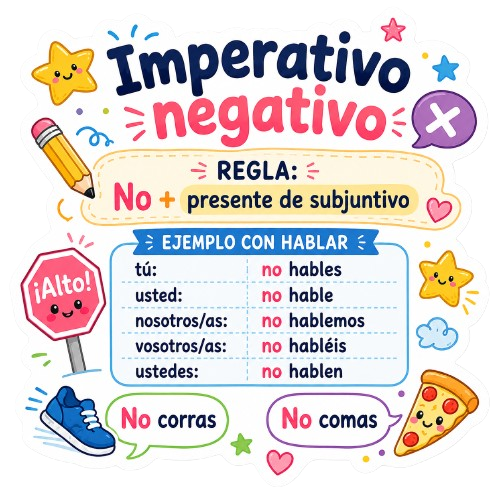
To form imperativo negativo, use a simple pattern: no + presente de subjuntivo. With regular verbs, the forms are quite logical. Verbs ending in -ar take endings similar to the -er/-ir group, while verbs ending in -er and -ir take endings from the -ar group.
| Person | hablar | comer | vivir |
|---|---|---|---|
| tú | no hables | no comas | no vivas |
| usted | no hable | no coma | no viva |
| nosotros/as | no hablemos | no comamos | no vivamos |
| vosotros/as | no habléis | no comáis | no viváis |
| ustedes | no hablen | no coman | no vivan |
Examples with tú:
No hables durante la película.
Don’t talk during the film.
No comas tan rápido.
Don’t eat so fast.
No vivas con miedo.
Don’t live in fear.
Examples with usted:
No hable tan alto, por favor.
Don’t speak so loudly, please.
No coma aquí.
Don’t eat here.
No viva pendiente de los demás.
Don’t live constantly focused on others.
The form nosotros/as often expresses the idea of “let’s not”:
No hablemos de eso ahora.
Let’s not talk about that now.
No comamos tan tarde.
Let’s not eat so late.
No vivamos en el pasado.
Let’s not live in the past.
The form vosotros/as is used in Spain when addressing a group of people informally:
No habléis todos a la vez.
Don’t all speak at once.
No comáis antes de la cena.
Don’t eat before dinner.
No viváis solo para trabajar.
Don’t live only to work.
The form ustedes is used in Latin America as the standard way to address a group of people. In Spain, it sounds more formal:
No hablen tan rápido.
Don’t speak so fast.
No coman en clase.
Don’t eat in class.
No vivan preocupados.
Don’t live in constant worry.
Irregular verbs are better learned separately. They are also connected with presente de subjuntivo, but their forms are not always obvious.
| Infinitive | tú | usted | vosotros/as | ustedes |
|---|---|---|---|---|
| ser | no seas | no sea | no seáis | no sean |
| estar | no estés | no esté | no estéis | no estén |
| ir | no vayas | no vaya | no vayáis | no vayan |
| saber | no sepas | no sepa | no sepáis | no sepan |
| dar | no des | no dé | no deis | no den |
| hacer | no hagas | no haga | no hagáis | no hagan |
| decir | no digas | no diga | no digáis | no digan |
| tener | no tengas | no tenga | no tengáis | no tengan |
| venir | no vengas | no venga | no vengáis | no vengan |
| poner | no pongas | no ponga | no pongáis | no pongan |
| salir | no salgas | no salga | no salgáis | no salgan |
Examples:
No seas tímido.
Don’t be shy.
No estés triste.
Don’t be sad.
No vayas solo.
Don’t go alone.
No me digas mentiras.
Don’t tell me lies.
No tengas miedo.
Don’t be afraid.
No hagas ruido.
Don’t make noise.
No pongas la mochila aquí.
Don’t put the backpack here.
No salgas sin chaqueta.
Don’t go out without a jacket.
With reflexive verbs, the rule is the same: the pronoun is placed before the verb.
No te levantes tarde.
Don’t get up late.
No se sienten aquí.
Don’t sit here.
No os preocupéis.
Don’t worry.
Imperativo negativo in Spanish is used much more often than it may seem. It is not only about strict prohibitions, but also about ordinary communication: requests, advice, and warnings. To use it correctly, remember three things: no goes before the verb, the verb form matches presente de subjuntivo, and pronouns come before the verb. Then phrases like no hables, no te preocupes, no lo hagas, and no me digas eso will sound natural.